Non-Instructional Time: Where Classroom Behavior Starts
Did you sign up to be a teacher but feel like a referee? If you are struggling with classroom behaviors, start by looking at your non-instructional time. While recess and lunch are considered non-instructional, I’m specifically looking at those little pockets of downtime that happen with the school day.
- The five minutes between activities.
- The student who finishes early.
- The assembly that gets canceled.
- The classroom guest who is running late.
- The technology that isn't cooperating.
These moments may seem insignificant, but they create unstructured time—and unstructured time is often when classroom behavior starts to unravel.
You can’t eliminate unexpected moments from your school day, but if you always have a back plan, you can limit downtime and classroom behaviors.
Here are my top 5 ways to limit downtime and improve student behavior. Make sure you read until the end, there is a free resource available to you!
1. Shorten Your Transitions
One of the easiest ways to reduce behavior problems is to take a closer look at how long your transitions actually take. Students probably need less time than you are giving them. You can time it yourself, imagine you told students to put away their reading supplies and pull out the math supplies. Try it yourself, how long does it actually take? A minute? Maybe two?
If you routinely give students five minutes to put away their materials and get ready for the next subject, there's a good chance that many students will use all five minutes. Not because they need 5 minutes, but because there is no sense of urgency.
Start shortening the amount of time students have to transition. You can always start with 1-2 minutes and if you see they need more time you can add more.
Fewer minutes spent wandering around, talking, sharpening pencils, visiting friends, or searching for materials means fewer opportunities for behavior problems to arise.
2. Use a Timer During Transitions
To go along with shorter transition times, a timer can be one of the simplest classroom-management tools you use. Instead of repeatedly telling students: "You need to get ready, we're waiting on you” or “Everyone should be seated."
Put the responsibility on the timer. "You have two minutes to be ready in your seat with your materials out”.
I purposely make this timer as large as I can to ensure students can see it. Most people (even adults) tend to move a little faster when they see a timer is going. It creates a little urgency without the teacher having to constantly redirect students.
The goal isn't to rush students but to eliminate unnecessary minutes when students don't have anything meaningful to do.
3. Always Have a Meaningful Early-Finisher Activity
One of the biggest mistakes we can make with early finishers is assuming that "Read a book" is enough.
Reading is wonderful. But if your only plan for students who finish early is "read quietly," you're going to have some students who finish their work and immediately start looking for something else to do.
Instead, have meaningful early-finisher activities that students can begin independently.
The key is that the activity needs to be:
- Something students can complete independently
- Engaging enough to hold their attention
- Easy to access
- Something they can work on for more than two minutes
Think about having a consistent early-finisher routine. When students finish their assigned work, they already know exactly what to do.
There's no waiting for the teacher. There's no wandering around the room. There's no asking what they should do next. They simply move on to the next meaningful task.
At the beginning of the school year I invested time prepping early finisher activities that were stored in a bin that could accessed anytime. Here are some activities I allowed students to do when they finished early:
Reading
- Write a postcard from one character to another.
- Write a different ending for the chapter or story.
- Design a new book cover for the book you are reading.
Math
- Sudoku™
- Wordle™ or Nerdle™
- Would you rather math questions like: Would you rather have $100 or $1 that doubles every day for 30 days?
4. Be Prepared for the Unexpected
Some downtime is completely outside your control: the power goes out, the assembly gets canceled or anything else that plans to completely derail the day.
These things happen, and when they do, you don't want to be standing in front of your class thinking: "Okay… what are we going to do now?"
Have a few backup plans ready to go at all times. Keep them somewhere accessible so you can pull them out immediately.
Your backup activities don't need to be elaborate lessons. Sometimes just a high interest text with an activity to go with it is just enough to get through that unexpected time. Prep it at the beginning of the school year so you never have to worry about it. These can work great as emergency sub plans as well.
5. Have No-Prep Activities for Those Random Five Minutes
This might be one of my favorite classroom-management strategies. Have activities ready for those weird little five-minute pockets that inevitably happen during the school day.
You know exactly what I'm talking about. The lesson ends three minutes early,your classroom guest is running late, you have five minutes before it's time to go somewhere.
Instead of scrambling to come up with something, have a collection of quick activities ready to go.
They should be:
✔️ No-prep or almost no-prep
✔️ Easy to explain
✔️ Engaging
✔️ Short enough to complete in just a few minutes
✔️ Easy to keep on hand
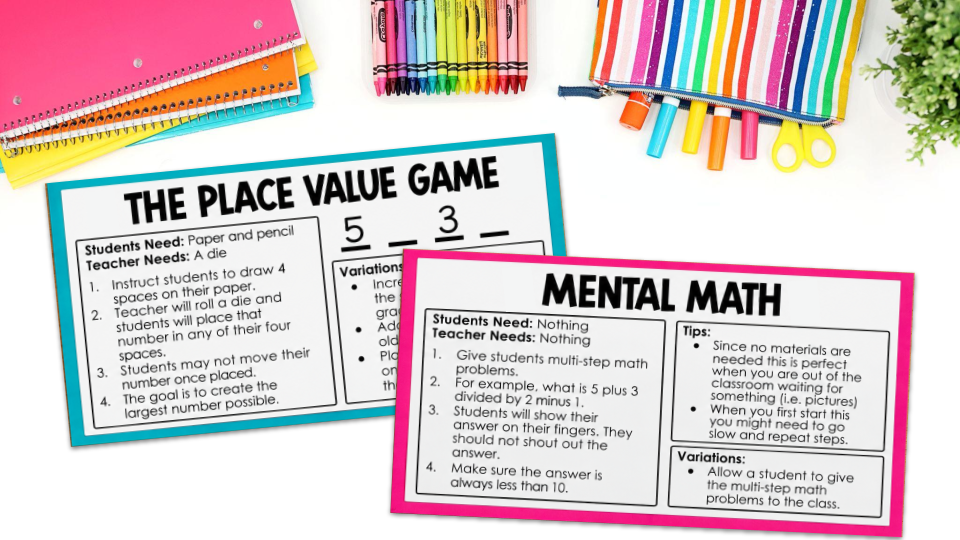
That's exactly why I created my 5-Minute Filler Cards!
These cards are designed to give you quick, engaging activities you can have printed, laminated, and ready to go whenever you need to fill a few unexpected minutes.
Keep them in a spot that's easy to grab.
When you have five minutes to fill, pull a card and go.
Just a quick activity that keeps students engaged and gives you one more tool for managing those little pockets of downtime.
You don't have to keep your students busy every second of the school day. Kids need breaks. They need opportunities to talk, move, and interact with each other.
But there's a big difference between intentional downtime and those unplanned minutes when students don't know what they're supposed to be doing.
Those are the moments when behavior can start to creep in. So take a look at your school day.
- Where do transitions take longer than they need to?
- What happens when a student finishes early?
- What happens when something unexpected changes your schedule?
Those are the moments worth planning for. Because sometimes the best classroom-management strategy isn't another behavior system. It's simply making sure students always know what comes next.
Visit
our blog to find other teaching hacks to make teaching easier.