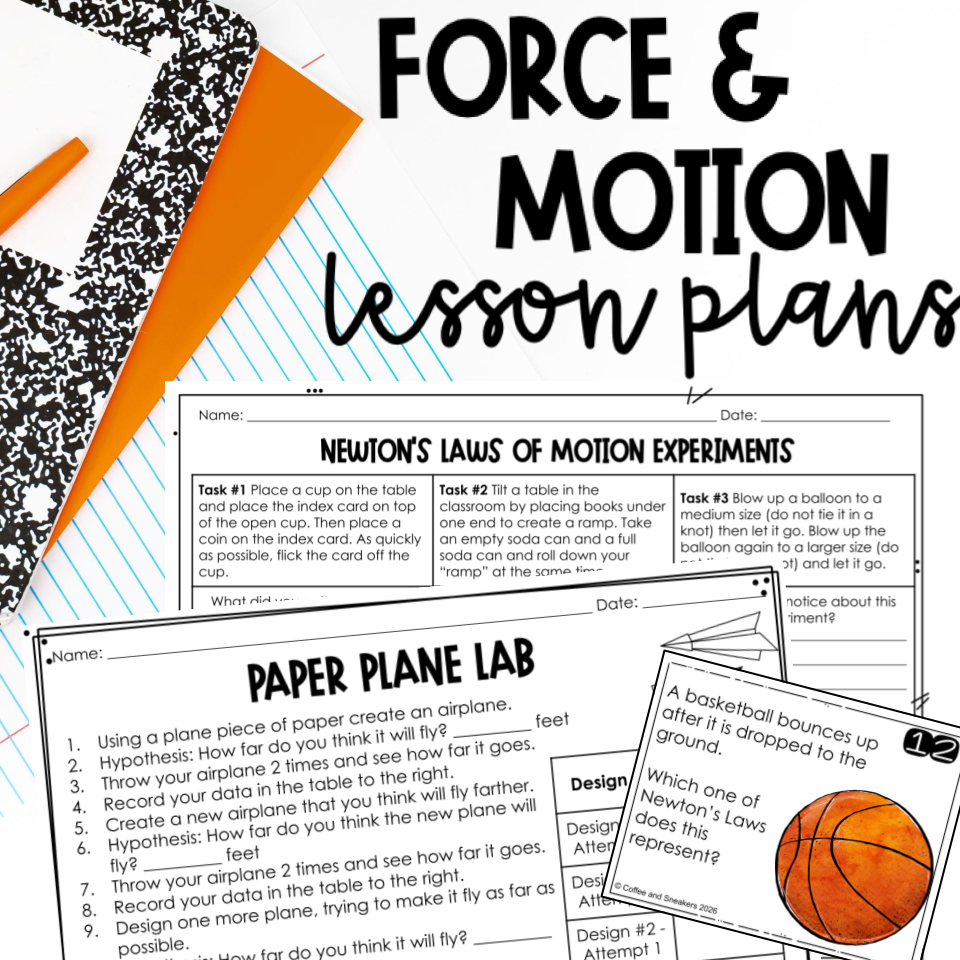
Looking for ready-to-use lessons on that? These activities are part of our 5th Grade Forces & Interactions Lesson Plans, which include detailed lesson plans, student recording sheets, videos, and many other activities to help students understand the relationship between force and motion.
How Force and Mass Affect Motion: Hands-On Science Activities
We know that the greater the force the greater the impact it will have on the motion of an object. We also know the greater the mass the more force it needs to move. But how do we teach this to our students? Here are two hands-on investigations that will help students to understand these two concepts.
Exploration #1 - Wind Power
Time: 20-30 minutes
Materials:
- A variety of types of balls (marbles, ping pong, tennis ball, baseball, basketball, rubber ball, beach ball etc).
Steps:
- The goal is to get the ball across the room, using only your breath.
- Take your ball to one end of the classroom. You and your classmates will compete against each other.
- When your teacher says go, move your ball across the classroom using only your breath. You and your partner can trade places at any time during the race.
Student Observation:
Students will observe the more mass the object has the more force (breath) is needed to move the object.
Exploration #2 - Big Bad Wind
Total Time: 45 minutes
Materials:
- 5 toothpicks (per group)
- 4 popsicle sticks (per group)
- 1 paper plate (per group)
- Small container of play-doh (per group)
- Piece of aluminum foil (12 x 12 piece per group)
- Small Fan
- Blow Dryer
Steps:
- The goal is to build a house with the provided materials that is strong enough to withstand 3 types of wind.
- Start by building a small house on top of the paper plate. There is a 20 minute time limit.
- Your teacher will try to blow down each house with three types of winds (breathe, fan & blow dryer).
Student Observations
- Students will observe the stronger the force the more movement it causes.

FAQ
What materials did you use?
For the first investigation we asked students to bring in balls from home. We asked them to be creative and find anything they think no one else might have. We saw marbles, beach balls, rubber balls, ping pong balls, sports balls and billiard balls! Note we did tell students the goal of the activity which definitely made them think twice about what type of item to bring in.
For the second investigation any brand of popsicle sticks, aluminum foil and toothpicks will work. For Play-Doh™* we used
these small containers*. Students don’t need a lot and these were actually leftovers from our creature project from our
heredity unit. We also purchased a small fan. The fan we used is quite old now and not available but
this is the closest one* to what we used. For a blow dryer we just used ours from home. If you don’t have one ask your fellow teachers, someone definitely has one they can lend you.
See what you can find or borrow before buying anything! You likely have or can find all of these items for free. We just wanted to share links to products we had used for these investigations that were useful.
What prior knowledge should students have?
For these investigations students should know what a force is and what mass is. If you follow the 5E instructional model these activities would come during the “explore” section. Interested in what the 5E model is: get my free guide here!
Should students use the fan and blow dryer?
We suggest the teacher uses the fan and blow dryer instead of students. This is because we want the same amount of force and time to be used. The teachers can ensure each group is treated fairly.

Learn how reducing classroom downtime, shortening transitions, planning for early finishers, and having quick backup activities can help prevent behavior problems.

Discover a simple way to teach weather by tracking and graphing daily conditions, using real-time data to build vocabulary and science skills.

Explore matter, physical and chemical properties, and chemical changes with an exciting elephant toothpaste science experiment for kids.

Discover how science scavenger hunts make hands-on learning easy and engaging, with simple activities for exploring matter, forces, and more.

Try the Stroop Effect for kids! This fun brain experiment explores attention, the nervous system, and how our brains process competing information.

Closed sorts vs. open sorts: discover how both strategies help students classify, identify patterns, explain their thinking, and develop deeper science reasoning.
Teach friction with this engaging investigation! Students compare toy car speeds on ramps covered with sandpaper, bubble wrap, and aluminum foil.

Looking for a meaningful ecosystem project? Learn how to host an Ecosystem Expo where students research biomes, create displays, and present their learning.

Discover hands-on human body system projects that help students explore the skeletal, muscular, digestive, respiratory, and more using simple craft supplies.

Teach Newton's Laws of Motion with quick, hands-on science activities using simple materials. Perfect for engaging elementary students.