Hexagonal Thinking to Promote Deeper Understanding
Over the decades it’s clear education has moved away from simple recall of information to promoting a deeper understanding of topics. The hexagonal thinking strategy encourages critical and flexible thinking while encouraging evidenced based reasoning.
Guess the Topic
Time: 20-30 Minutes
Materials:
- Paper hexagons
- Construction paper
- List of 10-20 words on a specific topic
Steps:
- Provide a list of 10-20 words on a specific topic to students.
- Give them several small hexagons and construction paper.
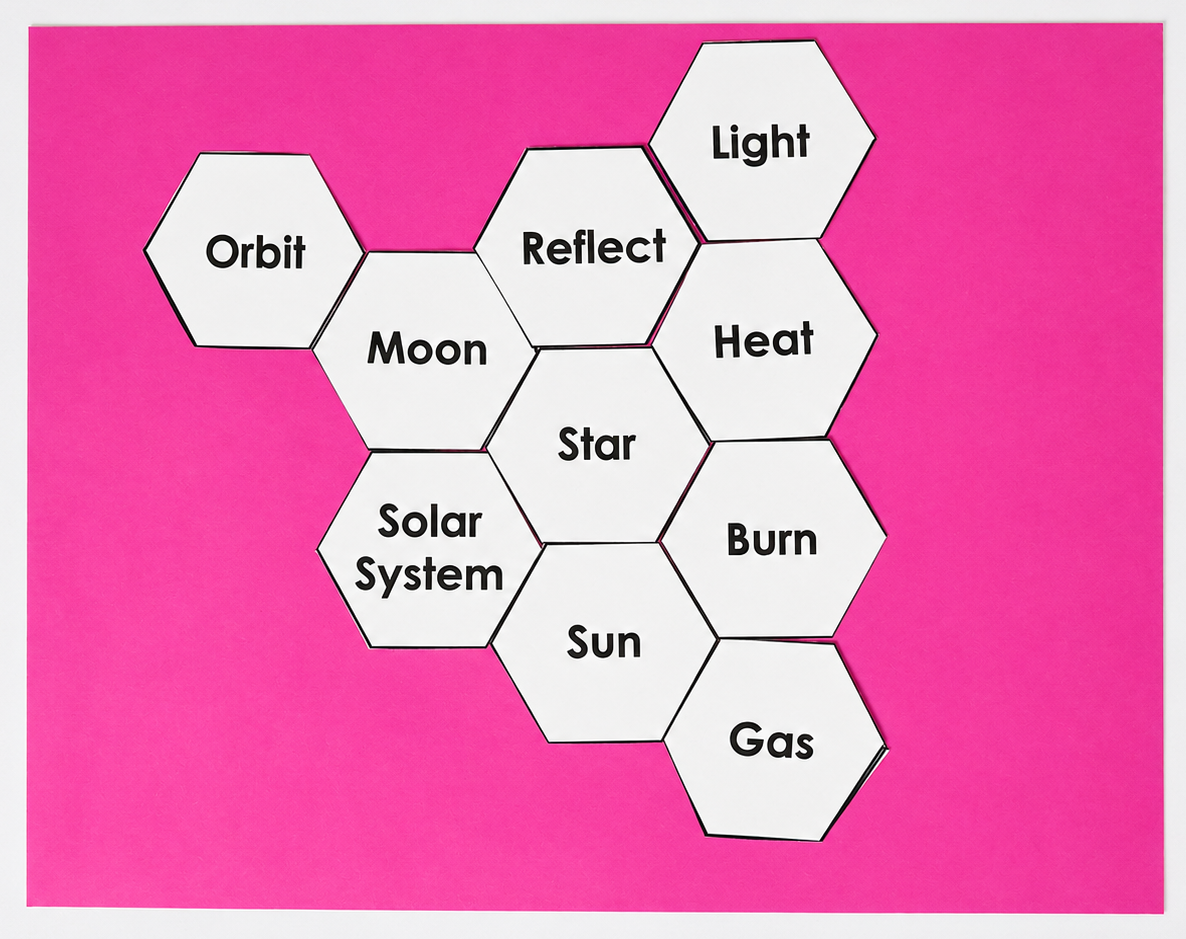
- Students will place one word on one hexagon and then organize the hexagon in a way that makes sense to them.
- The hexagons must touch each other and all words/hexagons must be used.
- Students can rearrange multiple times until they are happy with their product.
- When finished they will glue all hexagons to their construction paper.
- Students must be able to justify their thoughts in writing or verbally.


When to use it:
Hexagonal thinking works best when students have a deep understanding of a topic like at the end of a unit of study. Here are some ideas:
- Historical people from a social studies unit
- Laws or proclamations from a period of time
- Battles during a war
- Vocabulary from a science unit
- Shapes from a geometry unit
- Equivalent fractions or decimals
- Word problems with a focus on the operation
- Synonyms/antonyms or shades of meaning
- Characters, setting, themes from a piece of literature
- The steps in the writing process
- Types of emotions
Differentiation:
This strategy is already perfect for students who need more enrichment. However, if you have students need more rigor encourage them to partner with others and share their product and explain their reasoning. You can also ask them to sort the hexagons differently and explain which way is better.
For students who need extra support, reduce the number of words they have to organize or give them only a few words at a time to look at.
Benefits of this activity:
- Pushes students to think deeply Promotes critical thinking
- Encourages discussion and collaboration
- Shows students thinking and understanding
- Develops evidence-based reasoning.
Try
Hexagonal Thinking at the end of your next unit and be astounded at the level of knowledge your students show.
Discover more teaching strategies in the
Coffee and Sneakers Learning blog
Or have the classroom-ready ideas delivered straight to your inbox by
joining the Coffee and Sneakers newsletter. You’ll receive teaching tips, exclusive free resources designed to save you time and engage your students.